Product Case Study · PRD
Lead Generation & Assignment for Retailer Onboarding
A PRD I owned end-to-end across six milestones over roughly 18 months, from a broken lead-capture form to a full self-serve, paid-lead funnel. Restructured here for a portfolio audience, with company- and system-specific details generalized.
Problem Statement
The retailer sign-up website was generating leads, but a large share were fake, low-intent, or missing basic information needed to act on them. Conversion from lead to onboarded retailer sat around 17%, and field sales teams were spending time chasing leads that never should have entered the funnel.
Objective
- Filter incoming leads by capturing more qualifying fields at the point of submission.
- Increase visibility and discoverability of the retailer sign-up page itself.
Success Metrics
- Primary: raise lead-to-onboarding conversion from 17% to 40%.
- Secondary: ensure leads captured are exclusively from users with genuine intent to become a retailer.
Actors & Channels
- Actors: prospective new retailers.
- Channels: public website, field-agent mobile app, self-serve in-app flow (added in Milestone 2).
Milestone 0
Lead Capture Form & Website Revamp
Redesigned the form to gate on identity verification before collecting business details, and added fields needed to qualify a lead before it reaches sales:
- Full name
- Mobile number, OTP-verified — entry to the rest of the form is blocked until OTP verification completes
- Duplicate handling: if the number already belongs to an onboarded partner, the user sees a message directing them to support instead of re-submitting; if a lead for that number was already raised recently, the user is told a representative will follow up rather than being allowed to duplicate the lead
- Shop name and address (two lines), pincode with city/state auto-populated and locked, district/tehsil/block, landmark
- Current nature of business (dropdown, reused from the existing onboarding taxonomy)
- Whether the applicant already has a biometric device
Every submission gets a unique lead ID; a disclosure discloses onboarding is chargeable; a success message sets expectations (contact within 3 working days); every field's mandatory/optional status is configurable rather than hardcoded; and captured leads pipe to the field-agent app in real time.
On the website itself: "Login", "Register", and "Become a Retailer" all route directly to the lead form, which became the first thing a prospective retailer sees on the page rather than being buried below outdated earnings claims and imagery. Added a clear 4-step explainer (fill the form → sales rep contacts you → sales rep onboards you → start earning) and surfaced support contact for anyone who needed help before converting.
A daily/monthly reporting cadence was built alongside this to give the sales team visibility: a rolling 30-day feed, a monthly cumulative view broken into open/closed/other, and an aging column (days pending) so sales could triage by priority rather than by request order.
Milestone 1
Lead Visibility & Assignment for Field Agents
The hardest part of the spec: getting the right lead in front of the right field agent without a central dispatcher.
- Address strings from the web form get converted to lat/long via reverse geocoding, with a configurable fallback chain (full address → pincode only) if the first geocoding pass fails.
- A lead dashboard in the agent app with both map and list views, independently combinable search (name/number), lead-type filter, sort, and distance filter — defaulting to new leads within 10km, closest-first, last 30 days.
- Five lead states an agent can move between: New, Accepted, In Progress, Rejected, Converted — each with its own map/list card detail and its own configurable set of fields shown.
- Aging rules: a lead older than a configurable threshold auto-marks as "Not Picked" and notifies the lead by SMS; an agent who accepts a lead but doesn't act on it within a window loses visibility into that specific lead going forward (a configurable penalty, not a permanent one).
- Contact details stay hidden until acceptance — in the New view, an agent sees name, distance, and address but not the phone number; accepting reveals the full card with a tap-to-call.
- Configurable search radius by role (a promoter/distributor-level agent might search 25km, a zonal manager 100km).
- A generalized "remark" system: any outcome (not interested, converted via another number, follow-up needed) maps to a target lead state, and that mapping — plus the description text captured with it — is configurable rather than hardcoded per remark.
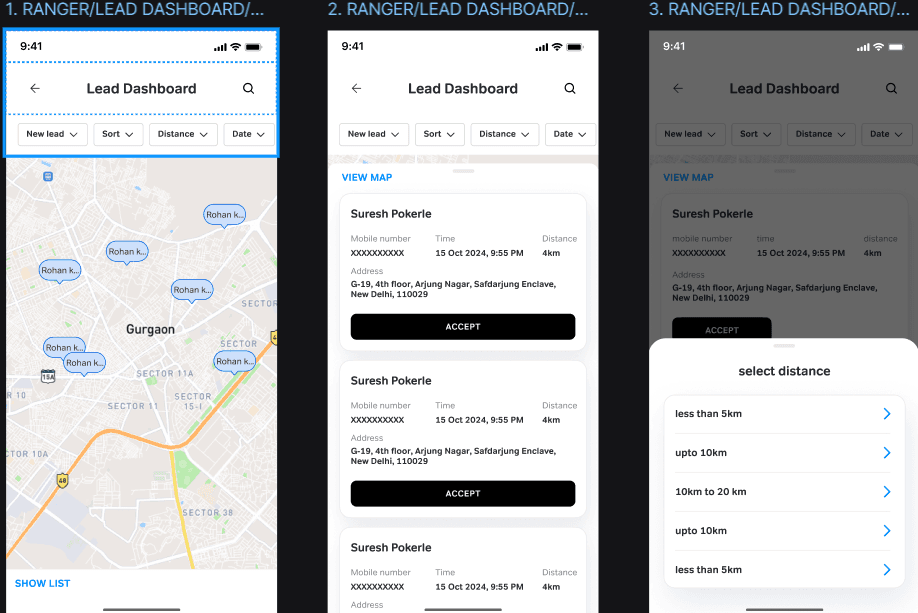
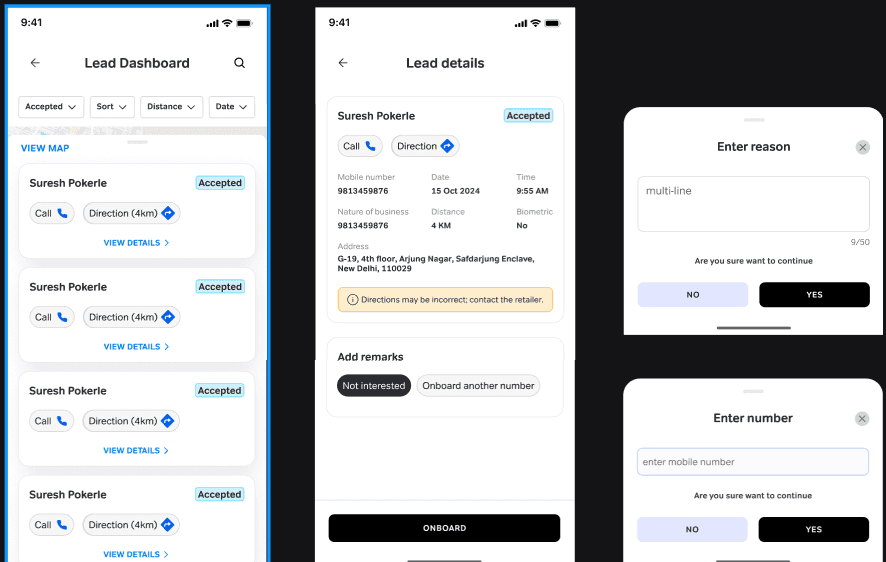
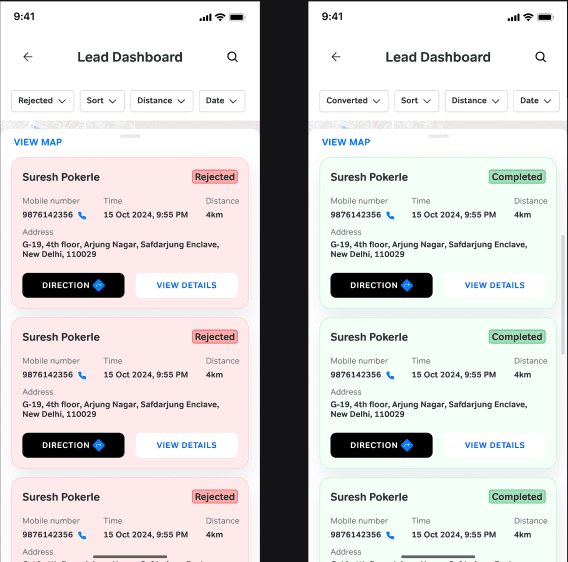
Wireframes from the ranger training deck built alongside this milestone. Names shown are demo/placeholder data.
Milestone 2
Self-Serve Lead Creation In-App
Extended lead capture beyond the website into a self-serve flow inside the retailer-facing app, letting a prospective retailer build their own lead without waiting for outbound sales contact:
- Mobile number entry and OTP verification, with dedupe checks against existing partner records before proceeding — an already-registered or already-blacklisted number is stopped at this step with a clear message.
- Aadhaar-based identity verification (face auth or biometric), with the same dedupe and blacklist checks re-run, followed by a summary screen showing the verified identity details back to the user for confirmation.
- Additional profile details (income, PAN, business nature) with a name-matching threshold between Aadhaar and PAN; mismatches surface specific, actionable error copy rather than a generic failure.
- Shop location capture using the device's current location by default (avoiding a second geocoding round-trip), with an edit option that falls back to the geocoding API if the user corrects it manually.
- A four-stage progress tracker (registration → sales visit → application submitted → onboarding complete) so the lead always knows where they stand, including failure states with next steps (resubmit, contact support) rather than dead ends.
- Leads originating from this in-app flow surface to field agents as "hot leads," visually distinguished from and prioritized over standard web leads.
Milestone 3
Charging & Refunds
The most significant strategic shift in the PRD: moving from free lead capture to charging an upfront, refundable fee, to filter out low-intent leads and pull onboarding revenue earlier in the funnel.
- Three-tier config, set per region: no charge, charge mandatory, or charge optional (pay-now vs. pay-later, each routed with a different service SLA).
- Consent language and a benefits page precede payment; paid leads are tagged distinctly through the whole pipeline (paid vs. hot vs. standard) and always shown to agents in that region only.
- Automatic refund after a configurable window if onboarding doesn't complete, plus a manual refund path for support-escalated cases — including a bulk CSV upload workflow with per-record status tracking, since escalations arrived in batches.
- A reporting layer purpose-built for this: unique leads started, unique converted, unique paid, in absolute numbers and conversion rate, sliceable by region.
Milestones 4–5
Follow-Up Scheduling & Refund Hardening
Later milestones tightened operational edges surfaced once the funnel was live at scale:
- A one-time, capped extension window so an agent actively following up on a lead isn't forced to lose it to the standard aging rule — deliberately limited to once per lead to prevent gaming.
- An escalation matrix for aging unconverted leads (notify manager at day 5, escalate up the chain at weeks 3–4) so stalled leads don't just sit silently.
- Hardened refund logic: refunds only fire against leads with a real, unclaimed payment sitting in escrow, with explicit rejection reasons (no payment found, already refunded, already transferred) surfaced back to the ops team rather than failing silently.
Outcome
This PRD became the basis for the rebuilt lead-generation and assignment tool, which now routes roughly 25,000 leads a month into the onboarding funnel. See the Lead-Generation & Assignment Tool card for the results.